


Intercom built the AI-helpdesk category, and its Fin agent is the most mature resolution bot in it. But that maturity arrives wrapped in a bill that climbs on two meters at once, a per-seat fee plus $0.99 for every Fin resolution, so the better the bot gets and the more you grow, the more you pay. sem.chat takes the opposite approach: one flat price per workspace, plus two things Intercom does not offer at all, real-time AI voice and a built-in CRM. For most SMB and mid-market teams, that mix of a predictable bill and more in the box is the smarter buy, and this guide shows you exactly why.
We compared both on six weighted criteria, set them up against real conversations, and sourced every Intercom figure from its own pricing page plus G2, Capterra and Reddit. On the sem.chat side, DaneriYachts is a live example: it added sem.chat to answer travel and yacht visitors instantly in their own language and stop losing leads. The one-line verdict, up front: unless you are a large enterprise that needs the single best resolution bot, sem.chat is the better value, because you get more (chat, real-time AI voice and a CRM) for a flat, predictable price. You can start a free sem.chat trial free in minutes, then move to the Launch ($24) or Growth ($59) plan once it is paying for itself. Here is the whole comparison at a glance.
At a glance: sem.chat vs Intercom
| Dimension | sem.chat | Intercom |
|---|---|---|
| Best for | SMBs wanting all-in-one chat + voice + CRM | Enterprise support at scale |
| Standout | Real-time AI voice and a built-in CRM, flat price | Fin, the most mature AI resolution bot |
| Watch out for | Newer; not an enterprise ticketing suite | Per seat + $0.99 per Fin resolution adds up fast |
| Starts at (as of June 2026) | Free, then $24/mo flat | $29/seat/mo + $0.99/Fin resolution |
| Real-time AI voice | Yes | No |
| Built-in CRM + scheduling | Yes | No |
| Free plan | Yes, no card | 14-day trial only |
| G2 rating | New entrant | 4.5 (3,855 reviews) |
Sources: GreetNow (speed to lead), Master of Code (AI-chat conversion), 6sense (AI-agent adoption), Salesforce (service orgs running AI), Fin AI (AI vs human cost).
The Intercom question in 2026
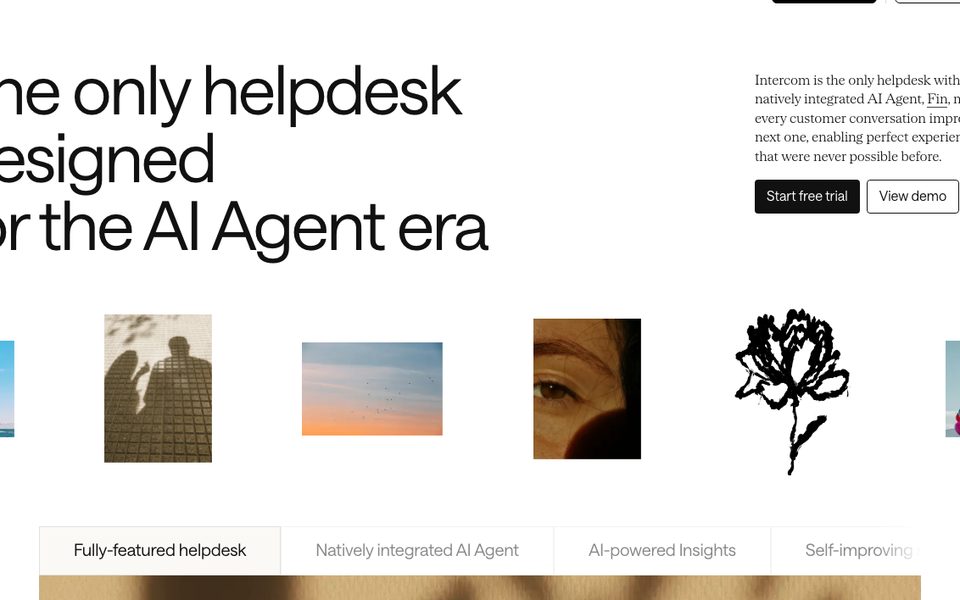
Let us be fair first, because Intercom earns it. Fin is genuinely best-in-class: it averages roughly a 76% resolution rate across thousands of customers, top performers clear 85%, and Intercom backs it with a $1M guarantee if Fin does not resolve at least 65%. The omnichannel inbox, the Copilot agent assistant, and the enterprise compliance posture (SOC 2, GDPR, HIPAA, 99.97% uptime) are exactly what a large support org needs. If your priority is the most capable AI bot at scale, Intercom is the safe answer.
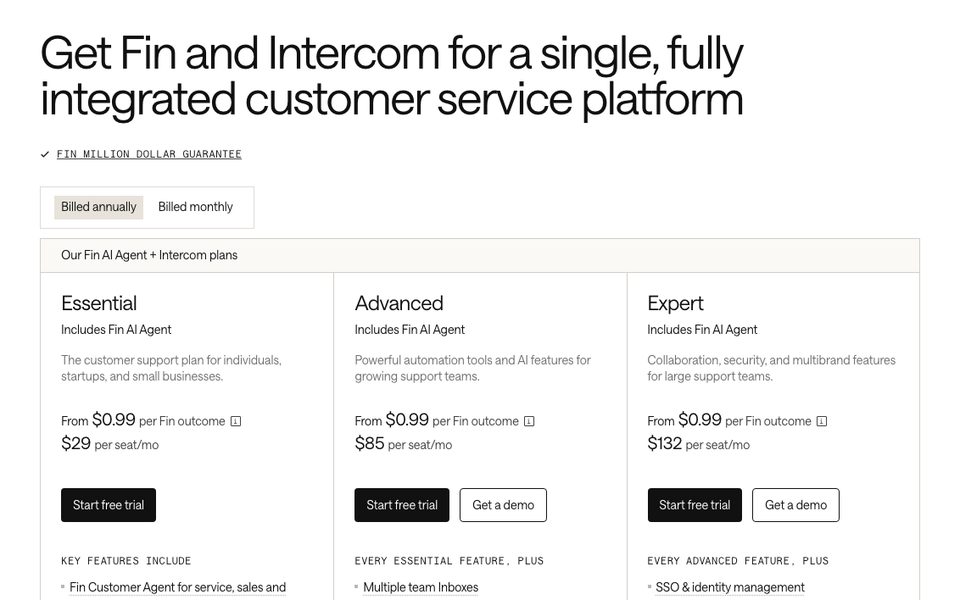
The friction is the bill. Intercom charges per seat ($29 Essential, $85 Advanced, $132 Expert) and then $0.99 for every Fin resolution on top, so the better the bot performs, the more you pay. That inverts the usual logic of automation, and reviewers feel it.
The mechanics are worth spelling out. A Fin "outcome" is billed at $0.99, a lead-qualification outcome at $9.99, with a 50-outcome monthly minimum, and as of 2026 even handoffs and disqualifications became billable events. Add the per-agent Copilot fee, usage charges for WhatsApp and SMS, and the optional Pro and Proactive add-ons, and the headline seat price is only the floor. None of it is hidden, but it is a lot of meters for a small team to watch every month.
- Intercom's per-resolution meter punishes success: as Fin resolves more, the bill climbs. Reviewers document one team jumping from about $200 to $1,400 a month during a single product launch. (Zipchat)
- The advertised '$85 a seat' turns out to be only about 46% of the real bill: a typical 10-seat Advanced setup runs near $1,833 a month once Copilot, the Pro and Proactive add-ons and 500 Fin resolutions are added. (Voiceflow)
- Long-time customers report bills jumping from about $119 to $854 a month after a plan change, with ongoing disputes over what Fin even counts as a resolution. (ClearFeed)
- A larger team documented spend climbing from roughly $4,000 to $9,000 a month at 40 agents, calling the pricing far more complicated than the marketing page suggests. (Kommunicate)
- The most-cited billing complaint: Fin charges its $0.99 fee on 'assumed resolutions', so a customer who simply goes quiet for 24 hours is billed as a success even when Fin was wrong. (Intercom community)
- As of 2026, handoffs and disqualifications became billable too, at $0.99 each, plus $9.99 per lead-qualification outcome and a 50-outcome monthly minimum, with little warning. (FeatureBase)
- By one multi-year pricing study, 78% of Essential-plan customers have to upgrade within six months, so the cheap entry tier behaves more like a trial than a plan. (SaaS Price Pulse)
- The invoice also hides a maintenance tax: teams report spending three to five hours a week reviewing failed AI resolutions and updating help articles to keep Fin accurate. (Kommunicate)
- Reviewers report waiting roughly a week for a first reply from Intercom's own support, and that annual contracts need an account manager to cancel, with no prorated refund. (Chatbotscape)
- Users also flag an upgrade treadmill: features that were in their plan at signup later moved to the pricier Expert tier at $132 a seat. (Capterra)
- In fairness, Fin is genuinely strong, resolving roughly two-thirds of questions on average with a money-back guarantee, which is why large enterprises tolerate the cost. (Fin AI)
None of that makes Intercom a bad product. It makes it an expensive, complex one, optimized for big teams that can absorb variable, usage-based cost. The rest of this guide shows how sem.chat covers the same core jobs, adds the voice and CRM Intercom lacks, and does it all for a flat, predictable price you can start at $24 a month.
Scored by dimension
We scored both tools out of 10 on the dimensions buyers actually weigh. The point is not a single winner; it is that each tool clearly wins different rows.
The honest read: Intercom wins AI-bot maturity, omnichannel depth and enterprise scale. sem.chat wins real-time voice, a built-in CRM, pricing predictability and speed of setup. Channels are close. Your decision comes down to which of those columns matters most to your team.
The real cost reality
This is the clearest reason an SMB looks past Intercom. The chart below estimates the real monthly cost of an Intercom setup at 5, 10 and 20 seats on the Advanced plan with moderate Fin usage, against sem.chat's one flat price. The gap is not subtle.
Because Fin bills $0.99 per resolution, your cost rises as your bot gets better and your volume grows; reviewers document bills jumping from a few hundred dollars to several thousand during busy periods. And the advertised seat price is only the start. Once you add Copilot, the Pro and Proactive add-ons, and Fin resolutions, a realistic 10-agent Intercom bill lands near $1,833 a month, roughly double the headline number.
A flat per-workspace plan erases all of that. sem.chat is the same $59 in a quiet month and a launch month, with chat, AI voice and a CRM already included, so finance forecasts it once and never re-explains it. That predictability is exactly why teams leaving Intercom over per-resolution bills look to flat-priced tools first. Pressure-test your own numbers with our SaaS cost savings calculator and the team math with the live chat staffing calculator, then start a free sem.chat trial and start on the Launch ($24) or Growth ($59) plan.
Feature comparison matrix
Note the rows only one side can tick: real-time AI voice and a built-in CRM (sem.chat), and a Fin-grade bot with enterprise compliance (Intercom).
| Capability | sem.chat | Intercom |
|---|---|---|
| AI chat bot (RAG-grounded) | Yes | Yes |
| Real-time AI voice agent | Yes | No |
| Hybrid voice + text in one widget | Yes | No |
| Multi-channel (WhatsApp, IG, Telegram, Messenger, Slack) | Yes | Partial |
| Unified inbox + human handoff | Yes | Yes |
| Built-in CRM (deals, pipelines, quotes) | Yes | No |
| Scheduling / booking (Calendly-style) | Yes | No |
| Most mature AI resolution bot | Partial | Yes |
| Enterprise compliance (SOC 2, GDPR, HIPAA) | Partial | Yes |
| Flat pricing (not per seat or per resolution) | Yes | No |
| Free plan | Yes | No |
Feature by feature
AI bots and resolution
Intercom's Fin is the deeper bot, with custom retrieval models, a documented resolution rate and a money-back guarantee. sem.chat's bot is solid: a RAG knowledge base you build by pasting your website URL, custom prompts and multi-bot management, and it adds something Fin cannot do, voice. Verdict: Intercom for pure bot maturity at enterprise scale; sem.chat for an all-in-one bot that also talks.
In practice the gap is narrower than the marketing suggests for everyday questions. Both bots answer from your own content, so for FAQs, order status, pricing and how-to questions a well-trained sem.chat bot and Fin land in the same place. Fin pulls ahead on long-tail, ambiguous and multi-step queries at high volume, where its custom retrieval and reranking models earn their keep, and where you are also paying $0.99 for each of those resolutions.
AI voice
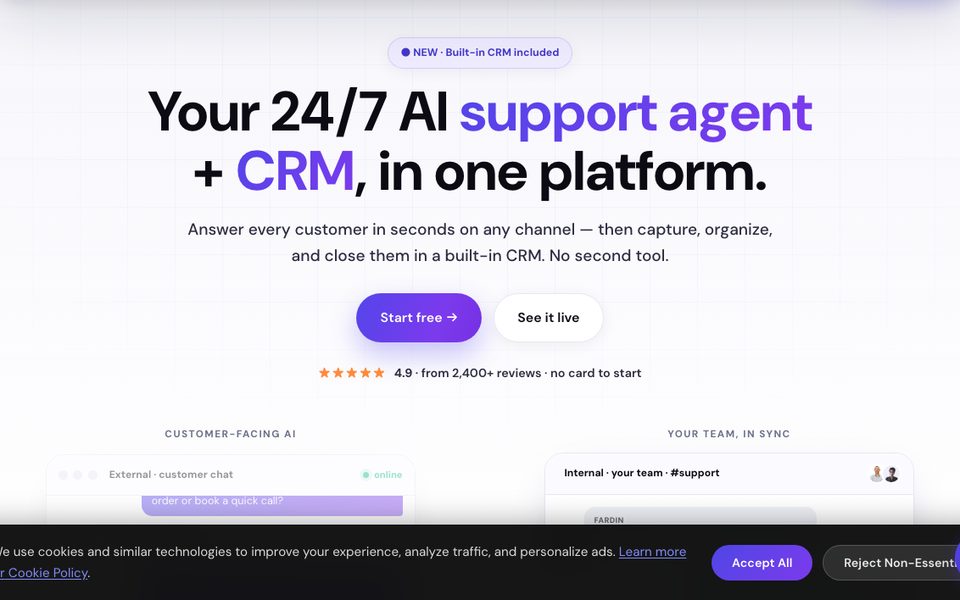
This one is not close. sem.chat offers real-time AI voice agents, 12 stock voices, optional voice cloning and beta talking avatars, plus a hybrid mode where a visitor switches between voice and text in the same widget. Intercom has no AI voice agent. Verdict: sem.chat, no contest.
Voice is not for every business, but where it fits it changes the experience. A visitor who would never type a long question will happily ask it out loud, and hands-busy, low-literacy or accessibility-sensitive audiences get a far better path than a chat box. Live transcripts and auto-generated voice summaries mean your team still gets a readable record. If talking to your AI is something your customers would actually use, Intercom simply cannot do it today.
Channels and inbox
Both run a unified inbox with human handoff. Intercom's omnichannel depth and Copilot are best-in-class for large teams; sem.chat spans the website widget, WhatsApp, Instagram, Telegram, Messenger and Slack with in-inbox auto-translation. Verdict: Intercom for depth at scale; sem.chat for breadth and price.
Intercom's Copilot, which drafts replies and surfaces knowledge for human agents, is a genuine productivity win for a large team and a real reason enterprises stay. sem.chat counters with smart human handoff, two-way auto-translation, and floating chat-link pills that route visitors straight to WhatsApp, Messenger, Instagram or Telegram. For a small team, that breadth out of the box usually matters more than the last 10% of inbox depth.
CRM and scheduling
sem.chat includes a genuine CRM (contacts, deals, multi-pipeline boards, quotes, invoices, e-signatures) and a Calendly-style scheduling module with Google and Outlook sync and Stripe-paid bookings. Intercom has neither; you bolt on Salesforce or HubSpot and a separate booking tool. Verdict: sem.chat, clearly.
This is the difference between a support tool and a revenue tool. Because every visitor who chats becomes a contact, and contacts convert to companies, deals and signed quotes in one click, an SMB can run its entire pipeline in the same place it answers questions, with no Salesforce seat and no separate booking bill. Intercom keeps you in support; sem.chat follows the conversation all the way to the deal.
Pricing and predictability
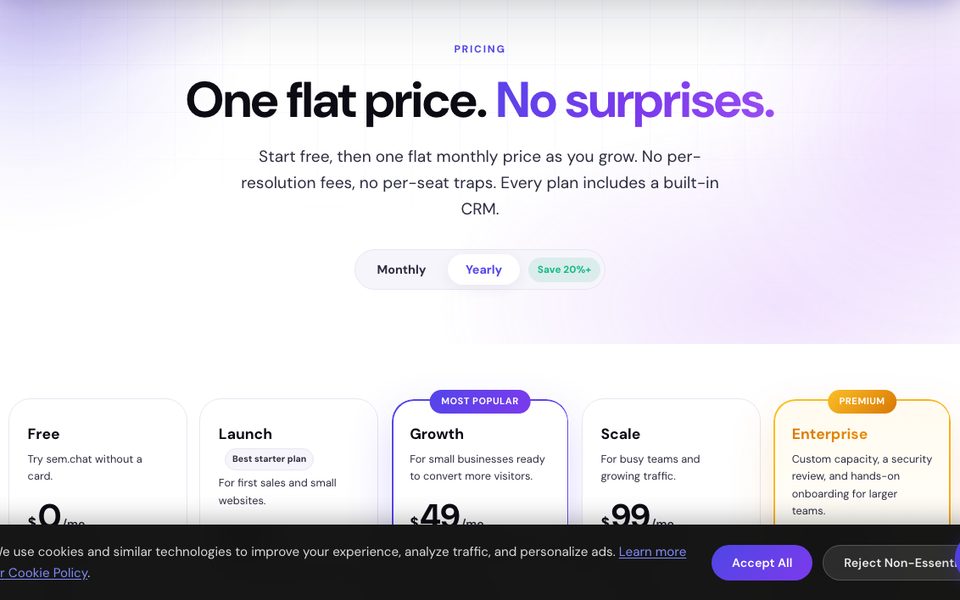
sem.chat is flat: a free plan, then Launch $24, Growth $59 and Scale $119 per month, with Enterprise custom. Intercom is per seat plus $0.99 per Fin resolution, so two meters move at once. Verdict: sem.chat for a number finance can predict; Intercom if you can absorb usage-based billing. Compare the tiers on the pricing page.
Work an example. A five-person team on Intercom Advanced is $425 a month in seats before any AI; add a thousand Fin resolutions and that is another $990, for roughly $1,400 a month that moves with your volume. The equivalent sem.chat plan is a flat $59 to $119, the same number in a quiet month and a launch month. Over a year, that is the difference between a line item you forecast once and one you re-explain to finance every quarter.
Ease and setup
sem.chat is built for self-serve: paste a URL to train the bot, drop in a one-line embed, go live in minutes. Intercom is powerful but has a steep learning curve and meaningful onboarding. Verdict: sem.chat for a fast, low-lift start.
The one-line embed works on WordPress, Shopify, Wix, Squarespace, Webflow or any HTML site, the widget speaks 17 languages automatically, and the free plan lets you trial it with no card. Intercom rewards the investment if you have the time and a dedicated admin; sem.chat is the one a founder can stand up over a weekend.
Scale, support and compliance
For a 200-agent operation with strict compliance and complex routing, Intercom's maturity, uptime SLA and certifications are the safer bet, and we will not pretend otherwise. Verdict: Intercom for enterprise scale.
If a security review, audit trails, role-based access, multibrand support and an uptime SLA are line items in your procurement, Intercom has answered them for years and sem.chat is younger on that front. This is the dimension where being newer is a real disadvantage, and we will not spin it.
How to choose
Map your situation to a pick instead of arguing in the abstract.
If you want pre-built support and CRM playbooks to test with, browse our free templates, and see how the wider field compares in our sister guides to Tidio and Zendesk alternatives.
sem.chat vs Intercom, head to head
The six dimensions that usually decide it, side by side.
The pattern is consistent with everything above: sem.chat wins voice, CRM, free access and flat pricing; Intercom wins AI-bot maturity and enterprise scale. Neither is universally better, only better for a specific team.
Switching from Intercom to sem.chat
If you decide sem.chat fits, moving is a few days of planning, not weeks. Be honest about the work.
The move is five honest steps. One, export your contacts, saved replies and conversation history from Intercom; the historical export is rarely a perfect 1:1, so expect some cleanup. Two, retrain the AI by pointing sem.chat at your website or help-center URL, then prune and re-tag content as you go. Three, rebuild your key workflows and handoff rules, where complex routing takes the most time. Four, run both in parallel for about a week so nothing slips, accepting a brief stretch of double cost. Five, retrain the team on the new inbox, voice and CRM, and budget a week for muscle memory to catch up. The 90-day plan below paces it so you are never firefighting.
Frequently asked questions
Is sem.chat a real Intercom alternative?
For an SMB or mid-market team, yes. sem.chat covers Intercom's core jobs (website chat, a shared inbox, human handoff) and adds real-time AI voice and a built-in CRM, at a flat price. It is not built to replace Intercom for a large enterprise support operation that needs the most mature resolution bot and deep compliance.
Is sem.chat cheaper than Intercom?
Almost always, yes, and more predictably. sem.chat is a flat $24 to $119 a month at any team size, while Intercom charges per seat plus $0.99 per Fin resolution, so an Intercom bill at 10 seats with moderate AI usage commonly runs into four figures a month.
Does sem.chat have an AI bot as good as Intercom's Fin?
Honestly, Fin is the more mature resolution bot, with a documented resolution rate and a guarantee. sem.chat's bot is strong and RAG-grounded on your own content, and it adds AI voice that Fin does not have. For pure text-resolution depth at enterprise scale, Intercom leads.
What does sem.chat have that Intercom does not?
Three things stand out: real-time AI voice agents (with voice cloning and beta talking avatars), a built-in CRM with deals, pipelines and e-signatures, and Calendly-style scheduling, all in one flat-priced platform.
When is Intercom the better choice?
When you run a large support team that needs the most capable AI resolution bot, the deepest omnichannel inbox, and enterprise compliance and uptime guarantees, and you can absorb usage-based billing. That is Intercom's home turf.
How hard is it to switch from Intercom to sem.chat?
Plan on a few days: export your data, point sem.chat's AI at your website, rebuild your key workflows, run both in parallel for about a week, and train the team. The biggest effort is recreating complex automations, not the data move.
The bottom line by team size
If you are a solo founder or a team under about ten people, sem.chat is usually the better call: you get AI chat and voice, a CRM and booking, and a bill that does not move, for less than a single Intercom seat-plus-Fin month. If you are a growing mid-market team, it comes down to whether AI-bot depth at scale outweighs flat pricing and an all-in-one CRM; many teams that do not need the absolute best resolution bot pick sem.chat and pocket the difference. If you are an enterprise support organization with strict compliance, hundreds of agents and complex routing, Intercom is the safer, more capable platform and worth its price.
Final verdict
There is no universal winner here, only the right fit. Here is who wins each use case.
Our recommendation: for the vast majority of teams landing on this comparison, sem.chat is the better fit, and it is the one we would pick. You get modern AI chat and voice, a built-in CRM and a bill you can actually predict, for less than a single Intercom seat-plus-Fin month. Only a large enterprise that needs the most mature resolution bot at scale should default to Intercom, and our full alternatives roundup covers the rest of the field.




