


If you are reading this, your Zendesk bill probably grew faster than your support team did. Zendesk is still a capable platform, but in 2026 its per-agent pricing stacks up quickly: the Suite Professional plan runs about $115 per agent per month, and the AI Copilot add-on is roughly another $50 per agent on top, according to Zendesk and third-party pricing analyses. For a five-person team that is real money before a single ticket is answered.
We tested seven alternatives hands-on, captured each one's live product, and read through hundreds of recent Reddit threads and G2, Capterra and Trustpilot reviews so this is not just a feature list. The honest verdict up front: there is no single best Zendesk alternative, only the best one for your team. Here is the whole field at a glance, with an honest pick for every team below.
Quick decision table
Skim this first. Prices are the entry paid tier, billed annually, as of June 2026, unless noted. Ratings are from G2.
| Tool | Best for | Standout | Watch out for | Starts at | G2 |
|---|---|---|---|---|---|
| sem.chat | AI-first SMBs that want voice + text + CRM in one | Real-time AI voice agents and a full built-in CRM | Newer; not an enterprise ITIL ticketing suite | Free, then $24/mo flat | New entrant |
| Intercom | AI-first SaaS support at scale | Fin AI agent quality | Outcome pricing is hard to forecast | $29/seat/mo + $0.99/Fin outcome | 4.5 |
| Freshdesk | An affordable, familiar Zendesk-style help desk | Easy setup, fair base price | AI and omnichannel add-ons spike the bill | $19/agent/mo (free 1 to 2 agents) | 4.4 |
| Help Scout | Small teams that want simple email-first support | Clean, friendly UI | Light AI, no phone | $25/user/mo (free up to 5) | Strong |
| Zoho Desk | Budget buyers, especially Zoho users | Lowest per-seat price | Cluttered UI, steeper learning curve | About $5/user/mo (free up to 3) | 4.4 |
| Gorgias | Shopify and BigCommerce stores | Deep ecommerce integrations | Per-ticket pricing gets confusing | $10/mo (per-ticket) | 4.6 |
| HubSpot Service Hub | Teams already living in HubSpot CRM | One platform for sales + service | Onboarding fees and annual lock-in | Free, then about $9 to $15/seat/mo | 4.4 |
| Stat | Figure | Source |
|---|---|---|
| CS leaders pressured to deploy AI in 2026 | 91% | Gartner (2026) |
| Service orgs running AI agents | 66% (up from 39%) | Salesforce State of Service 2026 |
| Common issues agentic AI will auto-resolve by 2029 | 80% | Gartner (2025) |
| Cost of an AI ticket vs a human ticket | $0.50 to $1.05 vs $8 to $12 | Sprinklr (2025) |
Why teams are leaving Zendesk in 2026
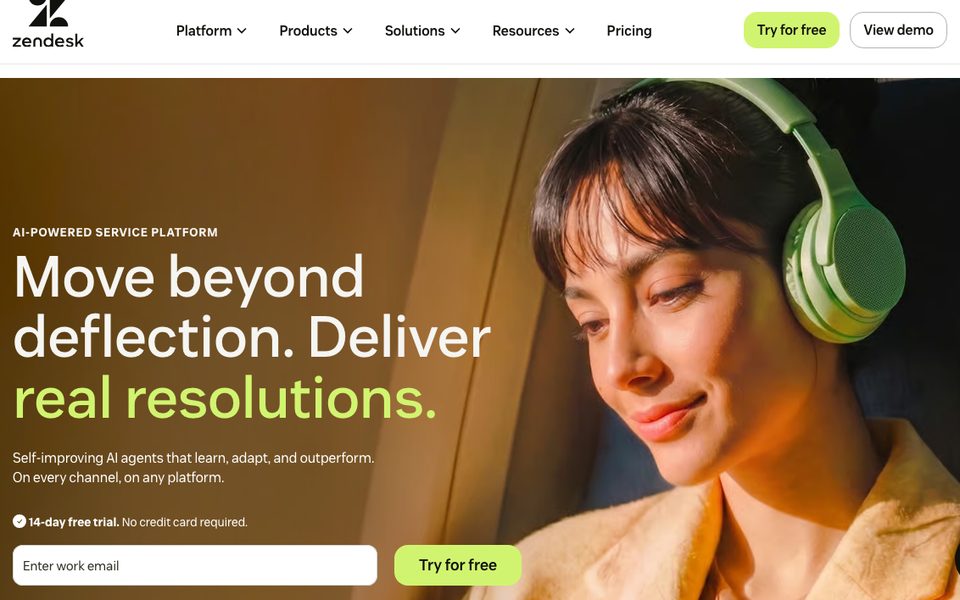
Zendesk is not bad software. It is mature, scalable, and trusted by large contact centers. The friction shows up for small and mid-sized teams in three places. First, cost: per-agent pricing plus AI add-ons means the real monthly number is often two to three times the headline price. Second, complexity: the ticket-queue model and deep configuration are overkill for a 3 to 30 person team that just wants fast answers. Third, AI economics: like Intercom, Zendesk has moved toward outcome-based AI pricing, so the better your bot performs, the more you can pay.
- Teams report the real bill landing 2 to 3x the advertised rate once Copilot, QA and workforce add-ons are switched on, with a 5-agent plan jumping from about $275 to $650 a month. (eesel.ai analysis)
- Several reviewers describe base-tier AI as feeling thin, closer to a routing layer than a true agent. (eesel.ai)
- Since early 2026, AI agent resolutions are auto-billed with no spending ceiling, which users say makes monthly costs hard to forecast. (Voiceflow pricing review)
- Post-acquisition, customers report slower, less responsive support and a steep setup curve for small teams. (Desk365 review roundup)
The market is voting with its feet. The customer-service software market reached roughly $13 billion in 2026 and most new entrants are AI-first rather than AI-bolted-on. If you only need a leaner, cheaper ticketing tool, several options below do that. If you want to genuinely modernize, look for AI that resolves rather than deflects, native messaging channels, and pricing you can predict.
How we scored the 7 tools
We scored every tool out of 100 across six weighted criteria, then matched each to the buyer it actually fits. The weighting favors what 2026 support buyers tell us they care about most: AI that works and pricing that does not surprise them.
One caveat on our own score: sem.chat ranks first on the weighted blend because it is strong on AI, channels, CRM and price, but it scores lowest of the group on enterprise scale and support maturity. If you run a 200-agent contact center, that 5 out of 10 matters more than the total, and Zendesk or Intercom is the safer pick. Read the scores against your situation, not in the abstract.
The real cost reality
Headline prices and real prices are different animals in this category. The chart below estimates the actual monthly cost of a roughly 10-agent setup once you add the AI features each tool needs to feel modern. It is the single clearest reason teams leave Zendesk: per-seat pricing plus AI add-ons compound, while a flat plan does not.
The pattern reviewers describe is consistent: Zendesk's real cost runs two to three times the advertised rate once add-ons are on, and Intercom bills can climb from $4,000 to $9,000+ as usage grows. A flat, per-workspace plan removes that anxiety entirely. Here is how the seven tools sit on price versus AI and all-in-one breadth.
Feature comparison matrix
This is where the differences get concrete. Note the two rows most tools cannot tick: real-time AI voice and a built-in CRM.
| Capability | sem.chat | Intercom | Freshdesk | Help Scout | Zoho Desk | Gorgias | HubSpot |
|---|---|---|---|---|---|---|---|
| AI chat bot (RAG-grounded) | Yes | Yes | Yes | Partial | Yes | Yes | Yes |
| Real-time AI voice agent | Yes | No | No | No | No | No | No |
| WhatsApp + Instagram + Telegram + Messenger | Yes | Partial | Partial | Partial | Partial | Partial | Partial |
| Slack channel | Yes | Partial | No | No | No | No | No |
| Unified inbox + human handoff | Yes | Yes | Yes | Yes | Yes | Yes | Yes |
| Built-in CRM (deals, pipelines, tasks) | Yes | No | No | No | Partial | No | Yes |
| Scheduling and booking | Yes | No | No | No | No | No | Partial |
| White-label widget | Yes | No | Partial | No | Partial | No | No |
| Flat pricing (not per seat) | Yes | No | No | No | No | Per ticket | No |
| Free plan | Yes | No | Yes | Yes | Yes | No | Yes |
The 7 best Zendesk alternatives
1. sem.chat - best AI-first all-in-one for SMBs
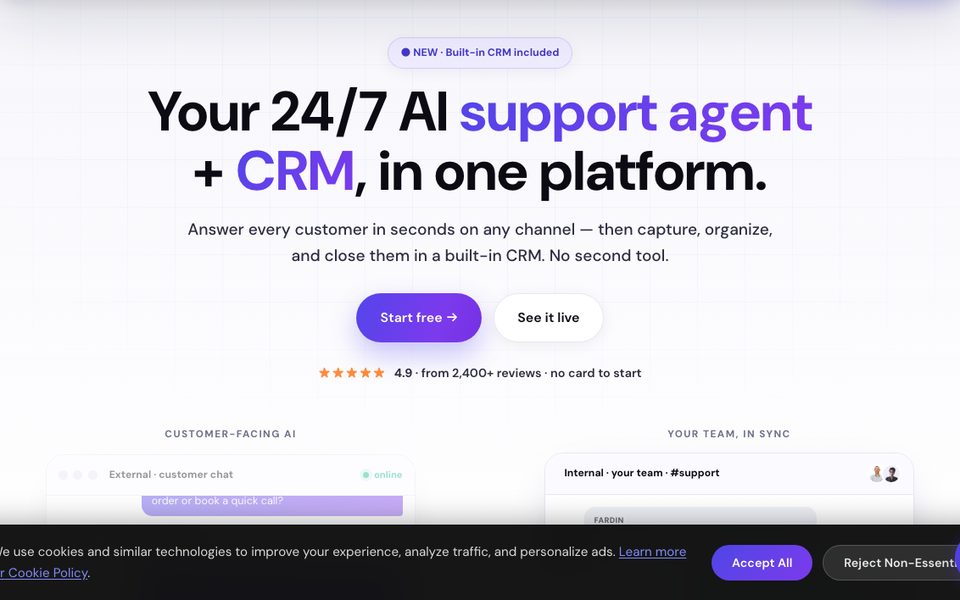
sem.chat is an AI customer support agent and a CRM in one platform, built for small and mid-sized teams that want to replace Zendesk's per-agent cost with a single flat subscription. It is the only tool in this comparison that pairs a text chatbot with real-time AI voice agents, so customers can literally talk to your AI, plus a full built-in CRM.
What stands out: an AI chatbot trained on your own content with a knowledge base you can build by pasting your website URL; real-time voice agents with 12 stock voices, optional voice cloning and beta talking avatars; a unified inbox spanning the website widget, WhatsApp, Instagram, Telegram, Messenger and Slack with smart human handoff and in-inbox auto-translation; a Calendly-style scheduling module; and a genuine CRM with deals, pipelines, tasks, quotes, invoices and e-signatures. You can white-label the widget and connect HubSpot, Salesforce or webhooks. See the full feature list for the detail.
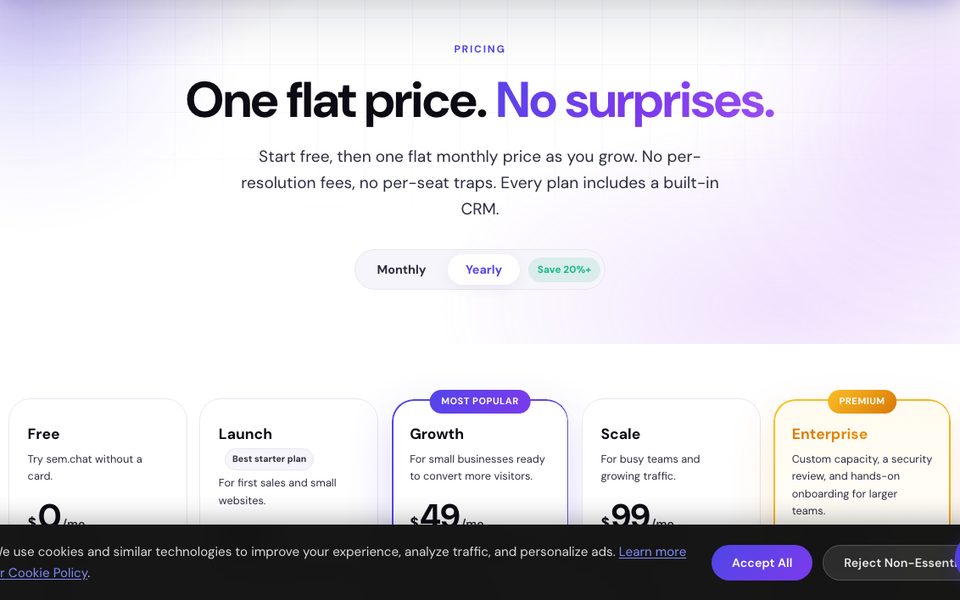
Pricing (as of June 2026): a free plan with no card required, then flat tiers of Launch $24, Growth $59 and Scale $119 per month, with custom Enterprise pricing. Pricing is per workspace, not per agent, which is the core difference from Zendesk. Compare the tiers on the pricing page.
2. Intercom - best for AI-first SaaS at scale
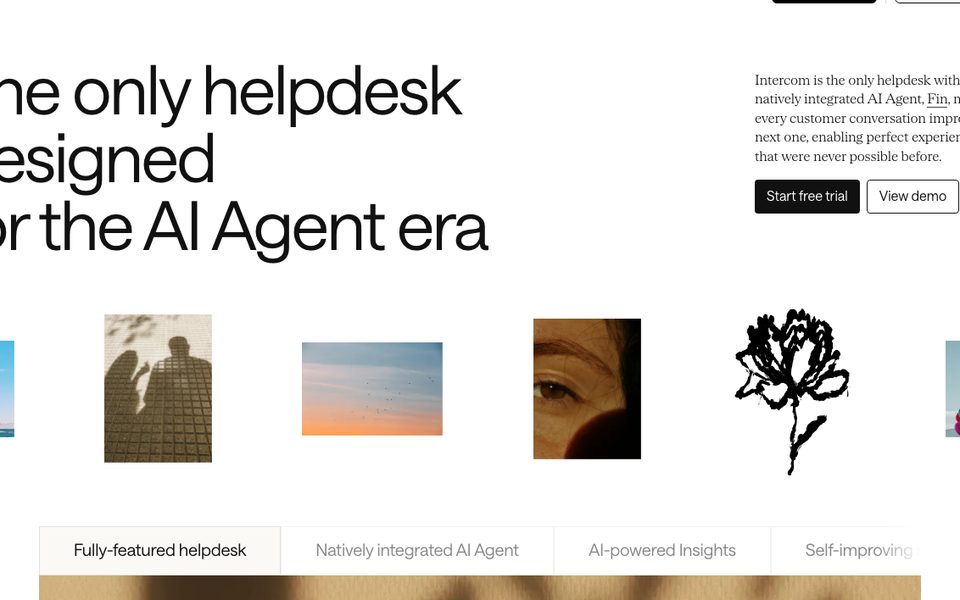
Intercom is the benchmark for AI-led support in product-led SaaS. Its Fin AI agent is widely regarded as the most capable resolution bot in the category, and the unified inbox across email, chat, SMS and WhatsApp is polished. If your priority is the best possible bot and you can absorb the cost, Intercom is hard to beat.
Pricing (as of June 2026): Essential $29, Advanced $85 and Expert $132 per seat per month, plus Fin at $0.99 per resolution. The most-cited complaint is exactly that outcome model: as Fin gets better, the monthly bill becomes harder to forecast.
- Reddit and review users report Fin's per-resolution fee makes bills rise as the bot gets better, with one documented jump from about $119 to $854 a month after moving to the new model. (Gleap pricing breakdown)
- The headline '$29 per seat' is described as roughly half of real spend once Copilot, proactive messaging and channel fees stack up. (industry review)
- Larger teams have documented monthly bills climbing from around $4,000 to $9,000+ once seats plus $0.99 per resolution plus channels combine. (Voiceflow pricing review)
- Some users say Fin can give unhelpful replies on nuanced questions and that tuning controls feel limited. (Hiver review)
3. Freshdesk - best affordable Zendesk-style help desk
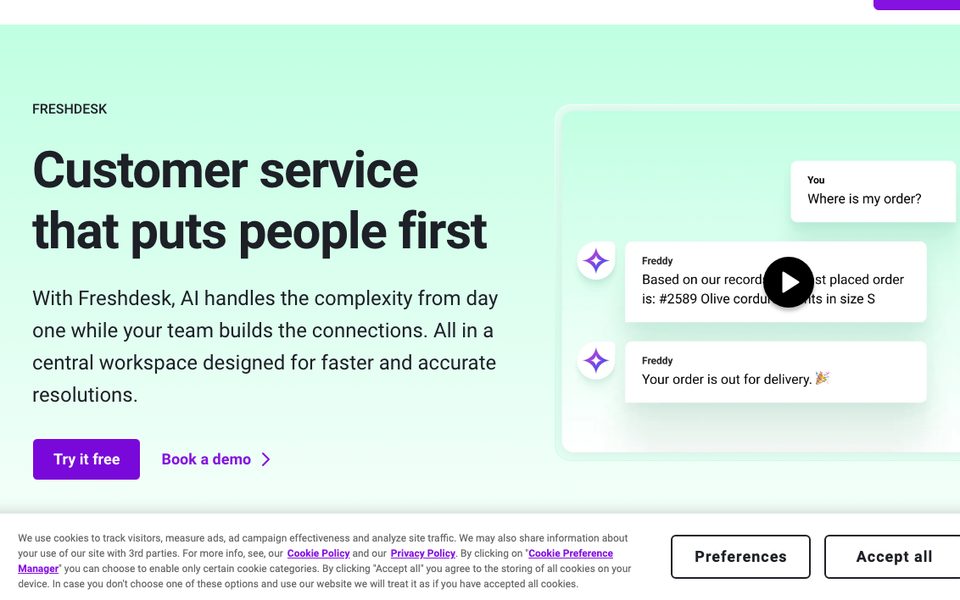
Freshdesk from Freshworks is the closest like-for-like swap for Zendesk: a familiar ticketing model, easier setup, and a lower entry price. A free plan covers 1 to 2 agents, and the Growth tier starts at $19 per agent per month. Freddy AI and omnichannel features sit in higher tiers, so the real cost climbs once you turn on automation. G2 rates it 4.4 across 3,700+ reviews.
- A recurring theme across reviews: teams outgrow Freshdesk within 12 to 24 months as workflows get more complex. (ClearFeed analysis)
- Reviewers say Freddy AI handles simple tickets but misclassifies anything complex, and note the AI is lagging behind rivals. (eesel.ai comparison)
- Long-running forum threads report the merge-tickets and search functions getting slow at scale, sometimes 30+ seconds. (Freshdesk support forum)
- Monthly AI session packs expire without rollover, so teams either over-buy capacity or get throttled. (eesel.ai)
4. Help Scout - best for simple email-first support
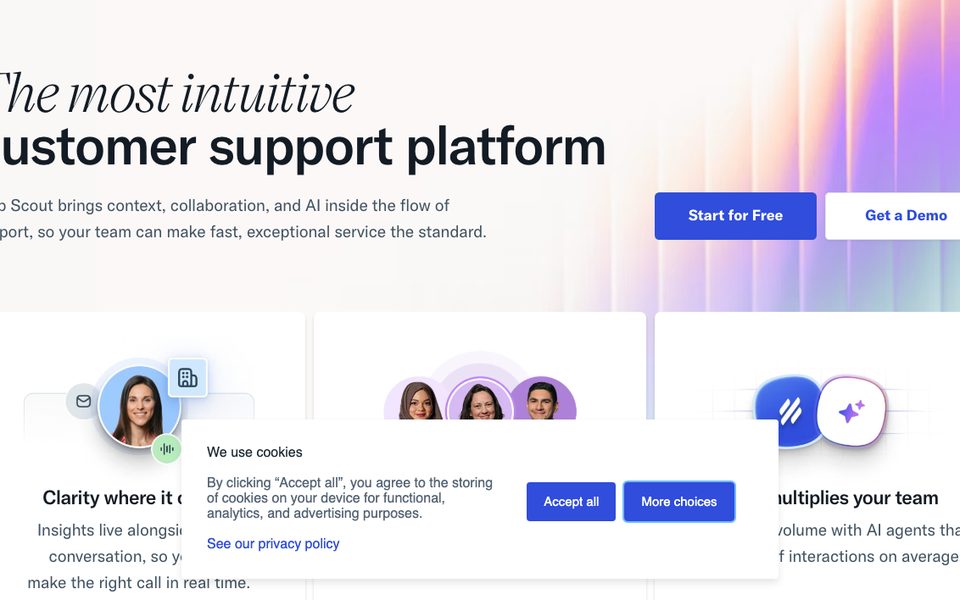
Help Scout is the friendliest tool here. It hides the help-desk machinery behind a clean, email-like inbox, which makes it a favorite for small teams that find Zendesk cold and complex. Pricing starts at $25 per user per month with a free plan for up to five users. Its honest limit is AI depth: AI Answers learns only from your Help Scout Docs, and there is no phone support or heavy automation.
- Reviewers love the clean, email-like inbox and rate it 4.6 out of 5 on Capterra; it is a favourite first help desk for small teams. (Capterra)
- The common limit cited: no native chatbot builder, so automation depth trails Zendesk and Intercom. (industry review)
- Teams note there is no native WhatsApp, voice or SMS, so omnichannel needs third-party tools. (Help Scout guide)
- Advanced reporting and workflows sit behind the higher tiers, which makes cost-effective scaling harder. (industry review)
5. Zoho Desk - best budget pick
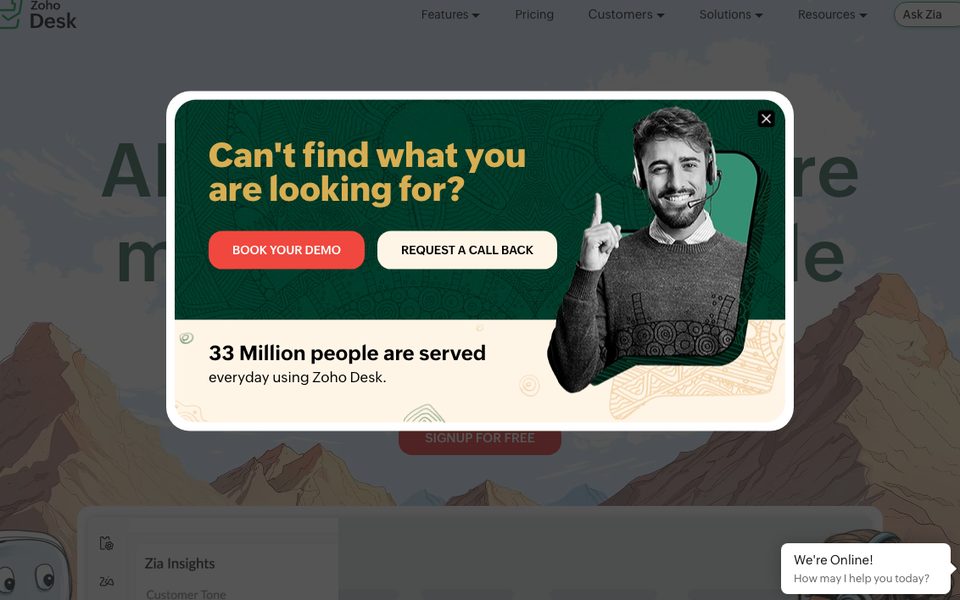
Zoho Desk is the value leader, with paid seats starting around $5 per user per month and a free tier for three agents. If you already run Zoho CRM or Zoho One, the integration is a strong reason to stay in the ecosystem. It is feature-rich for the price, with multichannel support, SLAs and an answer bot. The trade-off is the experience.
- Reviewers praise the low price but consistently flag a cluttered UI and a steep curve for advanced customization like Blueprints. (Capterra)
- Migrating from a legacy email setup is described as rough, with support that did not always understand the product during the move. (Capterra)
- Some users report slow loading and lag during high ticket volume. (G2)
- The strongest praise is for teams already inside the Zoho ecosystem, where the integration pays off. (G2 (4.4/5))
6. Gorgias - best for Shopify ecommerce
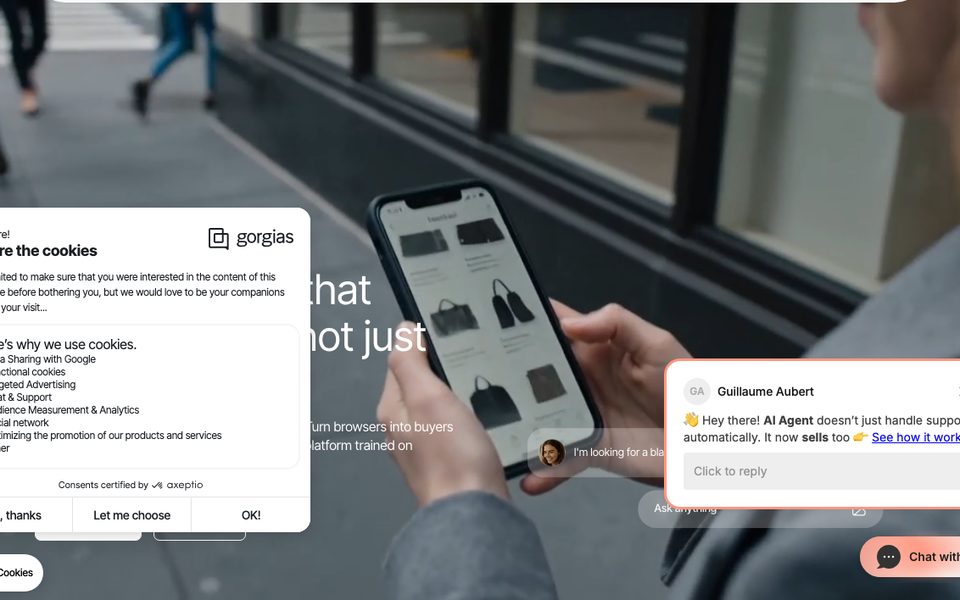
Gorgias is purpose-built for online stores. Its native Shopify and BigCommerce integrations pull order and product data straight into the conversation, and its AI agent can handle returns, refunds and order status. G2 rates it 4.6. The cautions are pricing and AI accuracy.
- Ecommerce users praise the Shopify-native experience: refunds, cancellations and order edits without leaving the help desk. (Trustpilot)
- The dominant complaint is pricing: ticket-based plus per-AI-resolution fees cause surprise bills, with one brand reporting roughly $14,000 in added AI fees on a ~$13,500-a-year plan. (Capterra)
- Users note AI-resolved tickets can be billed twice, once for the AI and once for the ticket. (Ringly review)
- AI response accuracy is reported around 59%, below the category average, so it needs human supervision. (Capterra analysis)
7. HubSpot Service Hub - best if you live in HubSpot
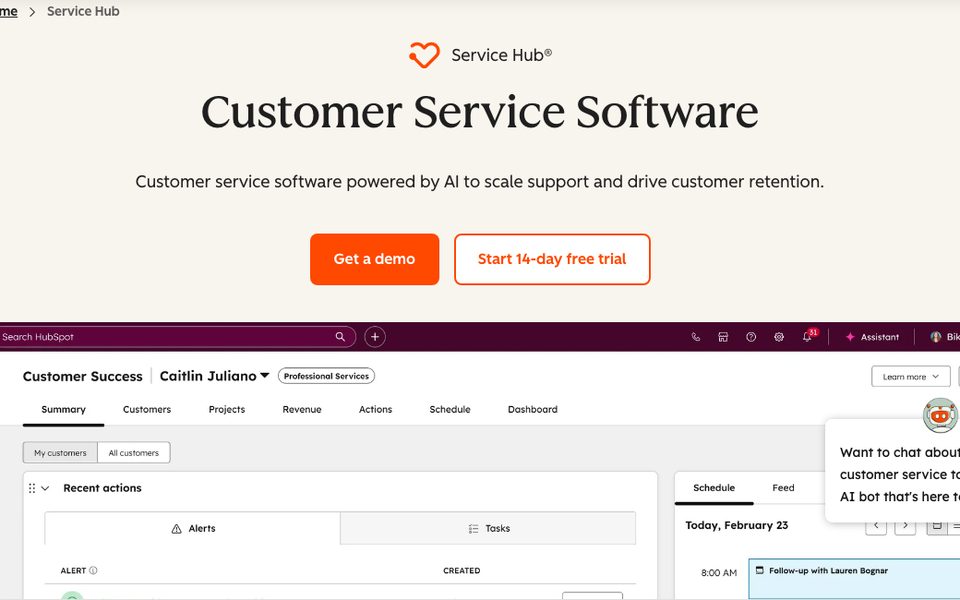
HubSpot Service Hub makes the most sense if your sales and marketing already run on HubSpot, because service, CRM and pipelines share one record. There is a free tier and a low-cost Starter, with AI in the Professional plan. Be aware of the onboarding fees and annual-contract terms below.
- Existing HubSpot customers love having service, CRM and pipelines on one record. (Capterra (4.4/5))
- The sharpest divide is billing: HubSpot scores about 2.0 on Trustpilot versus 4.4 on Capterra, with users reporting hard cancellation and annual auto-renewal lock-in. (Trustpilot)
- Professional and Enterprise carry one-time onboarding fees of $1,500 and $3,500, and key features sit behind the Professional tier. (FeatureBase pricing)
- Reviewers say knowledge-base customization is limited if you want branding flexibility. (Capterra)
How to choose the right one
Map your situation to a pick instead of chasing the highest score.
Whatever you shortlist, run a real pilot on your own conversations before you commit. Vendor demos look perfect; your edge cases do not. If you want pre-built support and CRM playbooks to test with, browse our free templates.
sem.chat vs Zendesk, head to head
Since you are here to replace Zendesk specifically, here is the direct comparison on the dimensions that drive the decision.
| Dimension | sem.chat | Zendesk |
|---|---|---|
| Pricing model | Flat per workspace, free plan, $24 to $119/mo | Per agent, no free plan, $19 to $115+/agent/mo |
| AI voice agents | Yes, real-time | No (phone/IVR, not AI voice) |
| Channels in one inbox | Web, WhatsApp, Instagram, Telegram, Messenger, Slack | Omnichannel, strong but largely add-on priced |
| Built-in CRM | Yes (deals, pipelines, tasks, quotes, e-sign) | Sell CRM sold separately |
| Enterprise ticketing and scale | Lighter; built for SMB | Deep; built for large contact centers |
| Setup effort | Minutes; paste a URL to train the bot | Higher; configuration and admin overhead |
The pattern is clear: sem.chat wins on AI breadth, channels, CRM and predictable cost for a small team. Zendesk wins on enterprise depth and scale. If you are a 200-agent operation with complex SLAs, stay on Zendesk. If you are a 3 to 30 person team paying enterprise prices for features you do not use, sem.chat is built for you. You can sanity-check the staffing math with our live chat staffing calculator and the return on switching with the ROI calculator.
Migrating off Zendesk
Switching is less scary than it looks, but be honest about the work. A clean migration is usually a few days, not weeks, if you plan it.
| Step | What to do | Honest friction |
|---|---|---|
| 1. Export | Pull tickets, contacts and macros from Zendesk | Historical ticket import is rarely a perfect 1:1 |
| 2. Rebuild knowledge | Point the new AI at your help center or website URL | You will prune and re-tag content as you go |
| 3. Recreate workflows | Map macros and SLAs to the new tool's automations | Complex routing rules take the most time |
| 4. Run in parallel | Keep Zendesk live for a week while you cut over | Brief double cost during overlap |
| 5. Retrain the team | Short sessions on the new inbox and handoff | Expect a week of muscle-memory adjustment |
Frequently asked questions
Is there a free Zendesk alternative?
Yes. sem.chat, Freshdesk, Help Scout, Zoho Desk and HubSpot Service Hub all offer a free plan or extended free tier. sem.chat's free plan needs no credit card, and Freshdesk covers 1 to 2 agents free. Zendesk itself has no free plan, only a 14-day trial.
What is the cheapest Zendesk alternative?
On pure per-seat price, Zoho Desk is the lowest at roughly $5 per user per month. On total predictable cost for a small team, sem.chat's flat $24 per month (not per seat) is often cheaper once you have more than two or three people, because it does not scale with headcount.
What is the best Zendesk alternative for a small business?
For most SMBs we recommend sem.chat, because one flat subscription covers AI chat, AI voice, six channels, scheduling and a CRM. If you only want a classic ticketing help desk, Freshdesk or Help Scout are excellent SMB picks.
What is the best AI-first Zendesk alternative?
sem.chat and Intercom are the two most AI-forward options. sem.chat is unique in offering real-time AI voice agents alongside text; Intercom's Fin is the most mature text resolution bot.
Is sem.chat a good Zendesk alternative?
For small and mid-sized teams, yes. sem.chat replaces Zendesk's per-agent pricing with a flat plan and adds AI voice and a built-in CRM that Zendesk charges separately for. It is not a fit for enterprise contact centers that need deep ITIL ticketing and large-scale SLA routing, where Zendesk remains stronger.
How hard is it to switch from Zendesk?
For an SMB, plan on a few days. Export your data, point the new AI at your website or help center, rebuild your key macros and routing, run both tools in parallel for about a week, and train the team. The biggest effort is recreating complex automations, not the data move itself.
Final verdict
There is no universal winner, only the right fit. Here is your 90-day plan to switch with confidence, then where each tool lands.
| Category | Winner |
|---|---|
| Best AI-first all-in-one for SMBs | sem.chat |
| Best AI bot at scale | Intercom |
| Best classic help desk on a budget | Freshdesk |
| Cheapest per seat | Zoho Desk |
| Best for ecommerce | Gorgias |
| Best for enterprise ticketing | Zendesk (stay) or Salesforce |
Expected outcome: a modern support stack at a predictable price, with AI carrying the routine load so your team handles the conversations that matter. If sem.chat is on your shortlist, you can start a free sem.chat trial in minutes, no credit card required.




